The DAC That Finally Made Me Understand Why People Chase Reference Sound
Section 01
The Story So Far
I have, over the last few years, owned an embarrassing number of DACs. Dongles. Pocketable USB things that looked like a USB stick on a diet. A FiiO BTR. An iFi Zen. A Topping E50 I sold within three months because I didn’t understand it. A Schiit Modi I kept far too long because I did. Most of them sounded, broadly, like music. A few sounded better than the others, although I couldn’t always tell you why.
Then, about six months ago, I got it into my head that I needed to hear what a “proper” desktop DAC and amp sounded like. Not a tiny puck. Not a streaming-app box. A unit. With weight. With a screen. With the sort of presence that requires you to choose, deliberately, where on the desk it lives.
I ended up with the Topping DX5 II. £299 worth of black metal and slightly aggressive Chinese hi-fi confidence. And the first thing I did, naturally, was distrust it.
“Reference” is one of those words audiophiles throw around the way wine people say “minerality”. Constantly. Pointedly. Never with a clear definition. A reference DAC, supposedly, is the one that doesn’t lie to you. The one that tells you what is actually on the recording, rather than what would be most flattering to play through your slightly nervous mid-fi headphones.
I, an ordinary person with a job and a partner who already mildly regrets the cardboard boxes piling up by the door, was very suspicious that this thing could justify its price.
And then I lived with it for a while.
What changed wasn’t excitement. It wasn’t amazement. It was something much quieter, and much more annoying to admit. It was trust.
Section 02
The Setup
What was plugged into what.
- Source: Mac mini via USB
- Headphones: HiFiMAN Edition XS
- IEMs: Moondrop Blessing 3
- Reference amp: Schiit Magnius
Section 03
First Impressions
The DX5 II arrives in a box that suggests Topping has, at some point, been told their packaging needed to feel more premium. It does. The unit itself is dense in a way that mid-fi gear rarely is. Genuinely heavy. The kind of weight that makes you wonder, briefly, if you’ve been undersold on what £299 should feel like in the hand.
The screen is small, sharp and slightly more useful than I expected. It tells you sample rate, source, volume, gain. The font is the same font every Chinese audio company has decided is the official font of grown-up hi-fi. I don’t hate it.
The controls are fine. The volume knob has the right amount of resistance — not loose, not stiff, not novelty-clicky. The buttons feel like they belong on a unit that costs about what it costs. No more. No less.
The remote is plastic. The remote is always plastic. Audio companies spend years engineering a flagship-grade DAC and then post you a remote that feels like it fell out of a 2009 Argos catalogue. I have made peace with this.
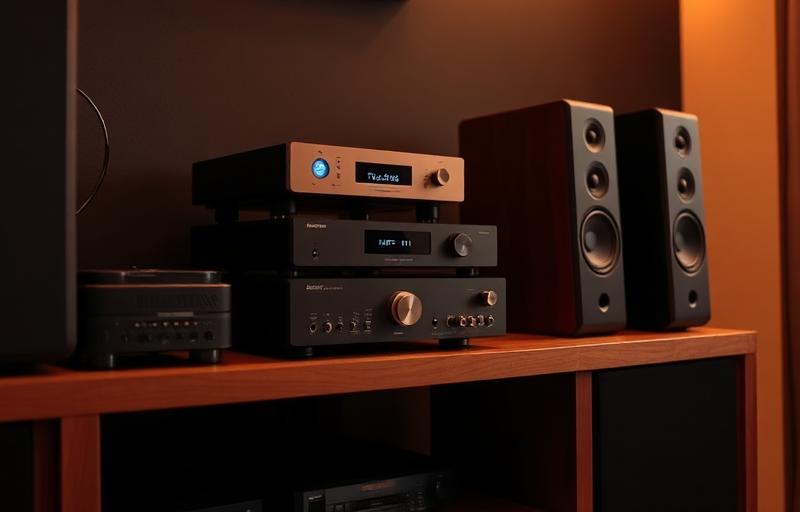
On the desk, it has presence without being a statement. It does not look like a piece of jewellery. It does not look like an art installation. It looks like a serious, sensible, slightly overbuilt tool that takes itself moderately seriously and expects you to do the same. Which is, on reflection, a fairly good summary of the brand.
Section 04
The First Listen
The first thing I noticed when I sat down to listen was that I didn’t notice anything in particular. Which sounds like a complaint and is, eventually, going to turn out to be the highest compliment I can give it.
I’d cued up a few of the usual suspects. A bit of Radiohead. Some Norah Jones, because of course. A live Bill Evans recording I keep specifically for moments when I want to be reminded what a piano sounds like in a room. I sat down. I pressed play. I waited for the moment.
There was no moment.
There was no “oh my god” reaction. No jaw-on-the-floor revelation about a guitar string I’d never noticed in twenty years of listening to OK Computer. Nothing rearranged itself in three dimensions. I didn’t weep. I didn’t turn to my dog and say “Henry, listen to this”. Henry would not have cared.
What I got instead was music that sounded like music. Confidently. Quietly. Without anyone trying to sell me anything.
And here, honestly, was my first audiophile crisis with this thing. Because I had spent £299 expecting fireworks, and instead I had been handed a very calm, very honest, very competent rendering of recordings I already knew well. My internal monologue was, more or less, “…is that it?”
I gave it a week.
“I didn’t fall in love with it. I just stopped arguing with it. That, it turns out, is the entire point of a reference DAC.”
Section 05
The Moment It Clicked
The moment it clicked was not during a critical listening session. It was during a working afternoon. I had it on in the background, headphones half on, jumping between writing emails and rewriting a sentence I’d already rewritten four times. A Tom Waits track came on. Then something by Big Thief. Then, by some Spotify algorithmic accident, a remastered Steely Dan thing I hadn’t heard in years.
Two hours had gone by. I hadn’t once thought about the DAC.
That, finally, was when I understood.
Every other DAC I’d owned had a personality. Some were warm. Some were thin. Some were “musical” in that audiophile way which usually means “rolled-off treble and a bit of artificial bass bloom”. They had a sound. The DX5 II, very quietly, does not. It just goes about its business.
And here is the part that took me an embarrassing amount of time to accept: I had been confusing excitement with quality.
When a DAC adds warmth, it’s flattering. When it adds bite, it sounds “detailed”. When it pushes the soundstage out wider than the recording really is, it sounds “wow”. All of these things grab you in a demo. None of them survive three months of listening to your actual record collection without starting to feel like a costume.
Reference, it turns out, is not a sound. It’s the absence of one. It’s the thing that stops getting in the way. It’s the equipment equivalent of a really good pair of reading glasses — invisible when you’re using them, immediately missed when you take them off.
I had spent years assuming reference DACs were for people who didn’t enjoy music. It turns out they’re for people who would quite like to enjoy the actual music, rather than the equipment’s opinion of it.
Section 06
Living With It
Day-to-day, the DX5 II has done a thing very few pieces of audio equipment manage. It has become invisible.
I reach for it without thinking. It’s on when I sit down. It’s on when I get up. It powers headphones, IEMs, the speakers on a quiet evening, the late-night film I watch through cans because I don’t want to wake the upstairs neighbour. It does all of that without ever needing me to fiddle with it.
I stopped doing the audiophile thing of swapping cables, switching inputs, comparing it to other DACs I happened to have on the desk that week. Not because I wasn’t curious anymore, but because every comparison I did kept producing the same answer: the other DAC was doing something. The DX5 II was just letting the music happen.
In any other product category, this would be table stakes. We do not praise washing machines for being “quietly competent at washing”. We do not write 2,000-word reviews of a sensible kettle. But in audio, where most of the industry runs on novelty, sparkle and tribal loyalty, a DAC that stops being interesting is, paradoxically, the most interesting thing it can do.
If that sounds like a backhanded compliment, it isn’t. It is, genuinely, the highest praise I have for it. The DX5 II has stopped being a piece of gear in my system and started being part of the furniture. Expensive furniture. Furniture I am very glad I bought. But furniture.
Section 07
The Reluctant Audiophile Reality Check
Now, the honest part. Because this is The Reluctant Audiophile, not a brochure.
First: the DX5 II is not for everyone. If you primarily listen to badly mastered streaming MP3s of music you don’t care that much about, you do not need this. You will get most of the way there with a £100 dongle and a slightly better pair of headphones. This is not a humblebrag. This is genuinely the maths.
Second: if you are buying audio equipment partly because you enjoy how it sounds — the warmth of tubes, the slam of a coloured amp, the slightly cinematic feel of a “fun” DAC — you might find the DX5 II quietly disappointing. It will not entertain you. It will not perform. It will not, in any meaningful sense, have an opinion. If you want opinions in your signal chain, buy them on purpose, somewhere else.
Third — and this is the one that gets me into trouble — most of the audiophile internet is, at any given moment, trying to sell you the idea that you can hear differences which are, in fact, marginal at best. Cables. USB regenerators. Decrapifiers. Bespoke linear power supplies that cost more than the DAC they’re plugged into. The DX5 II will, very quietly, expose how little most of that matters. Once you have a competent reference DAC, the “upgrade path” narrows dramatically. That is great for your bank account. It is very bad for the people who would like to keep selling you things.
Fourth: is it worth the money? On its own terms, yes. Genuinely, yes. You are paying for engineering, build quality, headroom, and the sort of long-term performance that means you will not be itching to replace it in eighteen months. Compared to the £150 dongles? Of course it’s overkill. Compared to the £1,500 boutique DACs people endlessly fawn over? It is, frankly, very difficult to justify spending three times this on a “better” one unless you have a very specific need or a very flexible income.
Fifth: it will not save you from the hobby. Nothing will. You will still browse. You will still convince yourself that maybe a tube amp would add some flavour. You will still end up on used-gear forums at midnight. The DX5 II just means that, when you’re actually sitting down and listening, none of that matters very much.
Section 08
Emotional Signature
Forget watts and ohms. This is how it actually feels.
Trust
9.5 / 10
The defining quality. After a fortnight you stop questioning what you’re hearing and just listen.
Excitement
6.5 / 10
Deliberately low. It is not trying to entertain you. That is a feature, even if it does not always feel like one.
Fun
7.0 / 10
Fun emerges from the music, not the DAC. Which is, in the end, the right way round.
Relaxation
9.0 / 10
Long listening sessions stop feeling like work. No fatigue, no fuss.
Goosebumps
7.5 / 10
Plenty, but always from the record, never from a clever piece of signal-chain theatre.
Value
8.5 / 10
Not cheap. But on a £-per-year-of-honest-service basis, very hard to beat.
Section 09
Financial Regret Forecast
The bit your bank statement secretly cares about.
Immediate Regret Risk
2.0 / 10
Low. The first week is underwhelming, but by month two you are quietly grateful.
Partner Approval Rating
4.5 / 10
It is black, it is sensible, it does not glow. The partner-approval ceiling for desktop DACs, frankly.
Likelihood Of Browsing More Audio Gear Anyway
9.0 / 10
Owning a reference DAC does not, sadly, stop you wanting a tube amp ‘just to try’.
Likelihood Of Telling Friends ‘It’s Different, Honestly’
8.5 / 10
You will say this. They will nod. They will not hear it. You will know.
Section 10
The ARSE Breakdown
Audio
Genuinely transparent. Holds up against equipment costing significantly more without flinching.
9.2 / 10
Regret
Low. The only regret is not buying it sooner instead of the three DACs you owned before it.
2.6 / 10
Spend
Not cheap, not cynical. Priced where serious mid-fi should be priced.
7.6 / 10
Enjoyment
Enjoyment is high once you adjust your expectations from ‘entertain me’ to ‘get out of the way’.
8.8 / 10
Overall
ARSE Score
8.3
Section 11
Who Should Buy This?
Buy It
You want resolution and control above all else and trust your headphones and ears to add the warmth.
Maybe
You listen to a lot of older rock and might prefer something with a touch more glow.
Walk Away
You are looking for a one-and-done musical hug. This isn’t that.
Final Verdict
And So
The DX5 II is not the most exciting bit of audio gear I have ever bought. It is, somehow, one of the most important. It quietly retired three other DACs in my house, ended a long-running argument I was having with myself about whether reference sound was even a real thing, and saved me, conservatively, several thousand pounds of future upgrade-itis.
If you came to this review hoping to be told that the DX5 II will transform your music — that it will reveal hidden layers, blow the roof off your soundstage, or make your favourite album sound new again — I am sorry. It will do none of those things. Those are the promises of equipment that wants to impress you in a shop.
What the DX5 II does is different and, for me, more valuable. It removes the question.
After enough time with it, you stop wondering whether your DAC is the limiting factor. You stop A/B-ing. You stop reading. You stop hovering over the “add to cart” button on whatever new boutique unit the forums are excited about this week. You just listen.
The DX5 II won’t make your music better.
It might just make you stop worrying about whether it could be.